
Knowledge infrastructure for complex organizations
Organizations in regulated industries generate enormous amounts of knowledge across engineering reports, calculations, regulatory filings, technical analyses, and internal documentation. Over time, that knowledge becomes difficult to find, connect, and reuse. Adeptus organizes this information into a structured knowledge layer called Codex.
The problem is not the lack of data
Important knowledge is often buried across systems, documents, and records that are difficult to connect and use consistently. As a result, engineers spend time searching for information, work is repeated, and decisions must be re-derived instead of reused.
Engineering reports, calculations, regulatory filings, figures, databases, and archives often live across separate systems.
Important ideas, analyses, and decisions may span many documents, but the relationships between them are rarely explicit.
Analytical tools are only useful when they can interact with company knowledge in a reliable and structured way.
Codex sits on top of your existing data systems and organizes the knowledge they contain
Your organization’s raw data is left unchanged and remains the source of truth. Codex does not replace existing systems. Instead, it organizes the knowledge inside them so information, decisions, and analyses can be connected, navigated, and reused more effectively.
Find information faster
Understand how documents relate to each other
Track how ideas, analyses, and decisions evolve
Give analytical tools safe access to company knowledge
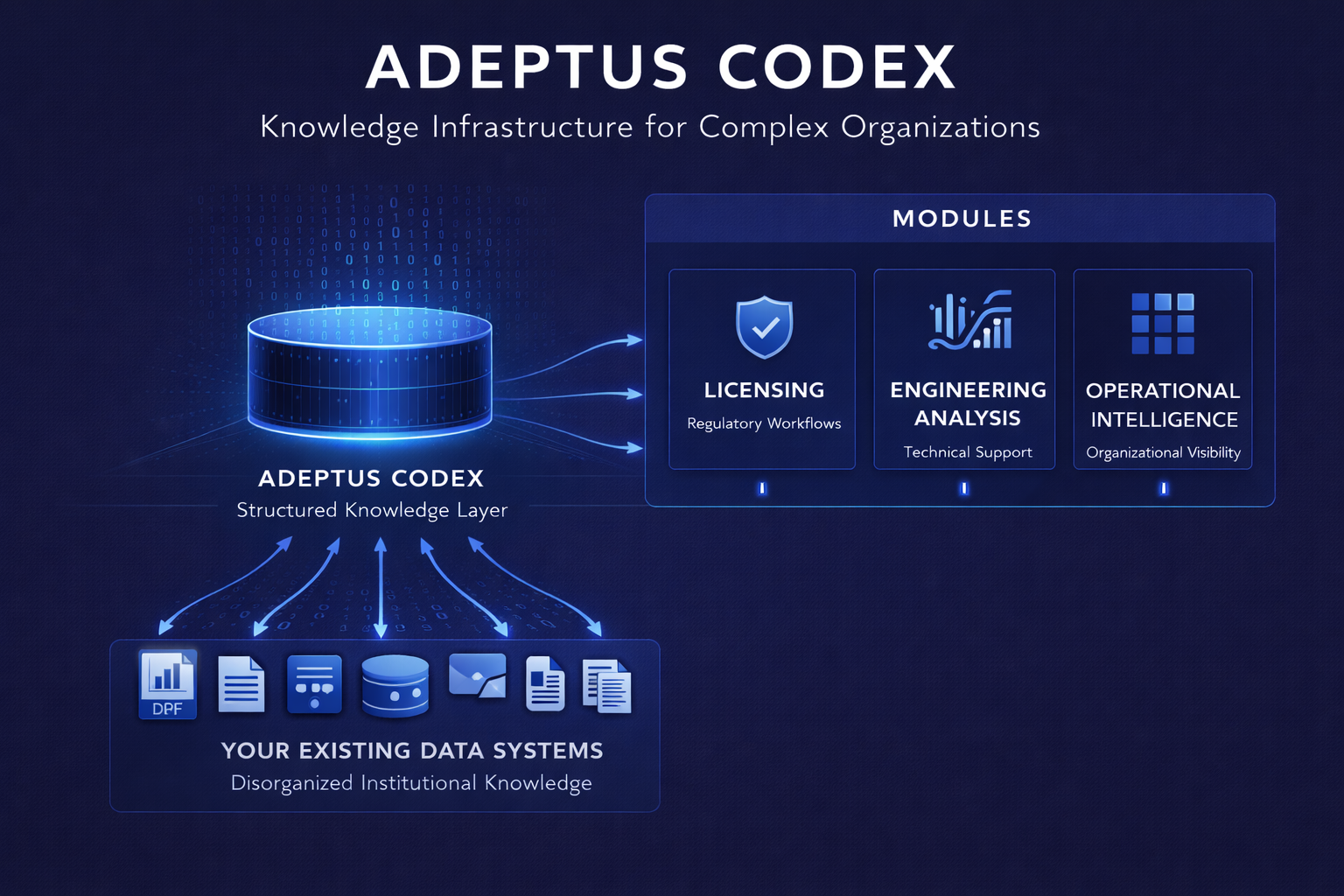
This allows organizations in regulated environments to adopt Codex without disrupting existing systems, security policies, or data governance.
Regulated organizations cannot move sensitive data outside their systems
For this reason, Adeptus is deployed inside your infrastructure. Codex works within your security posture rather than requiring you to move sensitive knowledge somewhere else.
Specialized tools built on Codex
Once knowledge is organized by Codex, specialized tools can connect to it. These tools are called Modules, and each one supports a specific workflow inside the organization. Because they operate on the same structured knowledge layer, new capabilities can be added without rebuilding the underlying data infrastructure.
Deployment is a collaborative process
Adeptus works directly with your organization to integrate Codex into your existing systems and workflows. No systems are replaced.
Adeptus connects to existing data sources such as document repositories, databases, and archives.
Adeptus engineers work with your team to organize institutional knowledge so it becomes easier to navigate, connect, and reuse.
Specialized modules are deployed to support specific workflows while remaining integrated with your systems.
Adeptus deployments are guided by engineers who work directly with your team
Every organization works differently. Forward Deployed Engineers work directly with your team to ensure Codex fits naturally into your workflows and systems.
Explore Adeptus Codex or see the first module built on top of it
Learn more about how Codex fits into your organization, or explore the Licensing module built on the same structured knowledge layer.